Showing posts with label lawrence krauss. Show all posts

Monday, June 04, 2012

Hitchens Tribute

I was not lucky enough to have met Christopher Hitchens, but have, on a couple of occasions, met and spoken to the great Lawrence Krauss. Krauss was lucky (as he would admit himself) to be considered a friend of Hitchens. Here is a remarkable tribute to Hitchens that Krauss gave at the 2012 Global Atheist Convention:


Sunday, February 05, 2012

ASU Origins: Something from Nothing


You'll have to forgive my little bit of hero worship. I went to the previously mentioned ASU Origins talk with Richard Dawkins and Lawrence Krauss. My seat was great (despite the iffy photo I took with my phone).

Something from Nothing was mostly as an informal talk about each of their current books: Dawkins' children's book The Magic of Reality and Krauss' Something from Nothing. The talk was unmoderated and bounced around quite a bit from evolutionary biology to cosmology to religion and politics. It was erudite and humorous and as has happened with the previous talks I've went to, I had a great time. Taking place in a packed Gammage Auditorium (the last public commission of Frank Lloyd Wright) on the campus of Arizona State University, it was gratifying to see so many smart people (young and old) who were willing to pay money to hear other smart people talk. I was lucky enough to speak to many of them before after the show. Getting to have a real conversation with rational people was an experience I don't often get. There may yet be hope for my generation and beyond.

During the last talk I attended, I was able to meet, talk with and get an autograph from Lawrence Krauss. This time, I made sure to stick around and speak to Mr. Dawkins. I had him sign the Magic of Reality book that I had bought for my son Alex for Christmas.


****************************************************

Update: You can view this talk online here: Something from Nothing

Wednesday, January 11, 2012

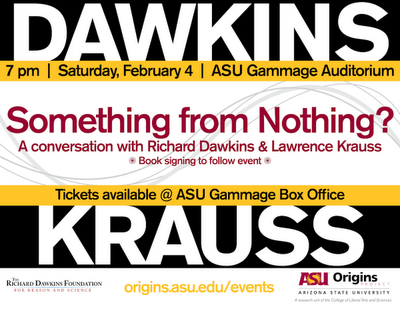
Something from Nothing?

Yes, I'm cool. Admit it. I'm getting to see Richard Dawkins for the 3rd time! Plus, Lawrence Krauss. I'm going to wait around to get Mr. Dawkins to sign one of my books this time.


Wednesday, February 16, 2011

ASU Origins Great Debate: What is life?

I was lucky enough to have attended the ASU Origins Great Debate: What is Life? at Arizona State University's Gammage Auditorium (a great venue designed by Frank Lloyd Wright) this past Saturday. Fittingly, February 12th is Charles Darwin's birthday. I had a great seat, front row off to the side a bit.


Project director Lawrence Krauss (theoretical physicist and famous author) spoke for about 10 minutes introducing each of the panelists: noted atheist and evolutionary biologist Richard Dawkins, Nobel Prize winning chemist Sidney Altman, Nobel Prize winning Lee Hartwell, NASA planetary scientist Chris McKay, theoretical physicist and author Paul Davies, and Biologist and entrepreneur J. Craig Venter. The debate began with each of the 6 panelists speaking for 5 to 10 minutes on their own, ostensibly to define what life meant in their opinion. Each of them took a different tact, predictably. Some said what differentiates life from something inanimate. Other explained how you would look for life.

Richard Dawkins spoke first, defining life it as that which can not only reproduce but also pass along its genetic code. Altman followed Dawkins and did not differentiate significantly from his definition. The next speaker, Lee Hartwell,a physician by profession, was perhaps the most out of place. His expertise is in cancer research and he was obviously intelligent but, self-admittedly, he did not have particular insight to this subject.

McKay was next and was perhaps my favorite of the speakers. The area at NASA which he works on pertains to looking for life on other planets (and moons). He spoke on several criteria that they look for to try and detect life but the most interesting to me was in how life affects other things on a planet. The geology and weather of Earth are completely different because of the existence of life. Oxygen wouldn't exist without plant life. Geologic characteristics such as fossil fuels and limestone would not exist without organic life. Maybe because of my education (aerospace engineering) and childhood dream to be an astronaut, McKay spoke to a lot of my aspirations.

Davies talked about the fact that life that would not necessarily be the carbon-based forms we know of. He even went out on a limb and said that non-carbon-based life would be discovered on Earth within 10 years. The study that was released last year was misinterpreted to have indicated that such life had already been found. Rather, the study indicated that a life form was found that scientists were able to substitute phosphorus for arsenic and it adapted. It's still significant in that it shows that life doesn't have to be carbon-based but nothing like this has been found natively.

The last to speak was Venter and he didn't really try to define what life was but seemed more intent on talking about how he was going to create artificial life. The relationship between Venter and the other scientists here is much like it is anywhere else ... contentious. He does not hide his disdain for theoretical scientists. If you can't experiment with something in the lab, it's not worthy of Venter. Research for knowledge's sake is not really his modus operandi but rather will it give him publicity. I don't want it to sound like I'm completely down on Venter. I'm not. People like him definitely have a place and I do believe his research is going to lead to advancements in curing of diseases. But he needs to be tempered by others lest he turn into a modern Dr. Frankenstein. Venter, for those that don't already know, was the first to map the human genome.


The event ended with a round-table between the panelists and Krauss. Nothing earth-shattering was revealed except for the general disdain that Venter has for regular scientists and they for him. Krauss brought up artificial intelligence to get the others take on whether that is life. It was his belief that that A.I. is the future of the human race. With no real concerted effort to advance space exploration, the problems of population growth and depleted resources are going to make our own planet unlivable in less time than some would believe (or blindly hope).

The amount of people attending what one would expect to be a dry scientific forum among erudite crusty professors with primarily British accents gives one hope that our youth value things other than reality TV and mysticism. This was not a talk about religion but it is hard for any discussion on science or the nature of life to not address that elephant in the room. When discussing the age of the Earth, Krauss made a joke about those states that lean towards the Creationist view of the age of the planet. And judging by the thunderous applause for his joke, I'd suspect that there was not a single soul in attendance with the belief that the Earth is 6,000 years old.

The real rock star of the panel, Dawkins, attracts adulation that seems incongruous for a distinctly middle-age Oxford type. And, I'm not making this up, I am convinced that several attractive young ladies in dresses and high-heels in the front row were Dawkins groupies. They even ducked out of the talk a few minutes early to assure themselves a spot near the front of the line to get their books signed. I would have liked to have gotten my book signed as well, but by the time I got out, his line was about 500 deep. We're not talking about Peyton Manning or Derek Jeter here. We're talking about an atheist evolutionary biologist. I settled for getting Lawrence Krauss' autograph and he was exceedingly gracious, talking to me a for a bit, shaking my hand and personalizing his signature.


I figure I'll get another shot at Dawkins as he's already been to ASU Origins symposiums at least three times and seems to be a friend of Krauss. My seat was on the side of the stage where Dawkins was and when he stepped to the podium, he was no more than 10 feet from me. Pretty heady stuff for an evolution and atheist nerd like myself.


I find it gratifying to go to places where smart people speak honestly and politely disagree on some points when necessary but agree on larger ones. Most importantly:
- the need for rational thought
- the need for math and science education
- the need to honestly address the issues of our planet
- to have our investigations and research lead us where they may instead of having a result pre-ordained and fit the facts to it

I'm looking forward to more of the ASU Origins events and plan on attending the next one in April, ASU Origins Project 2011 Science & Culture Festival.

Tuesday, April 07, 2009

Origins

I took the afternoon off on Monday and attended the Origins Symposium at ASU's Gammage Auditorium. This is a great venue that was designed by Frank Lloyd Wright.

Not wanting to pay for parking or to worry about traffic, I rode the Light Rail from it's westernmost point near Christown Mall down to Tempe. Some observations:

- For being a huge baseball fan, specifically of the Diamondbacks, I was apparently unaware of the fact that home opener was an afternoon game (12:40). Wisely, everybody and their mother were riding the light rail to the park. Wise for them, not me. I had to put up with a full train until we go to the park and about 80% of the people got off. I did strike up a great conversation with a guy in a wheelchair who was not going to the game. He was from New York and we chatted about the Mets and their new bullpen. Nice guy.

- Everybody needs to ride mass transit more often. And I'm not talking about the obvious, good-for-the-environment blah-blah-blah stuff. The majority of the people that ride trains and buses are not white, are not rich, are not "proper". The world of mass transit may not always be pretty, but it's real. I'll take real over pretty any day.

Before the conference, I picked up a couple of tacos at a new place called Hippie's Cove on Mill Ave in downtown Tempe. Good stuff.

Got to Gammage, which was about a half mile walk from the Light Rail stop on Mill. There was about a half hour until the afternoon session began, so I sat in the hall outside the auditorium with other attendees. Now, I consider myself fairly nerdy, but I'm frickin' the coolest guy in the world compared to this crew. But I meant that in the most positive sense. I wish I hung out with more of these types.

The main point of the conference was to discuss the following questions:

How did the Universe Begin?
How did life arise?
How does life evolve?
What is the Origin of Human Uniqueness?
What is the origin of disease?
How does consciousness arise?
How do human institutions arise and develop?
What will be the technologies of the future?

The conference started and the first speaker was introduced and came out. This was the main person I was coming for, Richard Dawkins. Nowadays, most people know him for his book, The God Delusion, but he was a hugely influential evolutionary biologist and that is what he was speaking on this day. He spoke for about an hour and took some questions at the end. They primarily dealt with evolution but one questioner tried to bring up atheism and was rebuffed by the moderator. This symposium was to deal with the "origins" of the universe, of life, etc. If you opened up the can of worms of religion, you could fill several more symposiums. Dawkins was funny, conversational, intelligent and I'm glad I finally had the chance to see him in person.

The second speaker was Craig Venter. He is generally considered to be the first to map the human genome. There is some controversy on this point, but Venter is very active in genomic research and we haven't heard the last from him. He has a non-profit organization with over 400 scientists that continue to work in this field. His talk was a bit dry for my taste, not as funny as Dawkins. And I wasn't as nearly interested in his subject matter as the other speakers. The questioners at the end of his talk generally seemed to ask about the ethics of genomic research and of patenting of genomes.

Lawrence Krauss, the head of the Origins Initiative at ASU and a world-renowned author and theoretical physicist, was the third speaker. I didn't know a a lot about him going in but was very impressed. He was very charismatic and funny. He organized the symposium and was able to assemble a large number of Nobel winning physicists and chemists plus a collection of some of the most popularly known scientists and intellectuals in the world (Dawkins, Brian Greene, Christopher Hitchens, Venter, Stephen Pinker, etc.) He primarily talked about the origins of the universe, its age, and its expansion. Though it was a scientific conference, he couldn't resist a gentle dig -- Krauss commented that the universe has been measured to be about 13.7 billion years old, except for those people in Texas at the school board he just spoken to the previous week.


The last presentation was a round table of 6 Nobel Prize winning scientists moderated by Ira Flatow of NPR's Science Friday. Flatow led the sometime contentious discussion by the following scientists: Sheldon Glashow, David Gross, John Mather, Frank Wilczek, Walter Gilbert and Baruch Blumberg. Though they were all courteous and generally amusing, you can sense some fundamental differences in how they viewed popular physics subjects such as string theory, supersymmetry, and the Large Hadron Collider. It was all incredibly fascinating and I wish I could listen to people like this all the time.

This presentation again ended with some audience questions and you knew someone would just have to put a fly in the ointment. Flatow had begun the presentation with a comment about how it was nice for science to now be viewed in a more positive sense and for it to have a seat at the table, unlike the last 8 years. This is a point that no rational person could disagree with and I would guess that 99.9% of the audience agreed with. Well, that one person that disagree had to ask a question. A lady came up and said that she had no idea what he was talking about when he said that science has not been appreciated politically or popularly recently. And even before she said it, I knew she was going to somehow dovetail this into a religious question. She brought up Francis Collins as a means of saying that religion and science can coexist. For those who don't know who he is, he is a geneticist very instrumental in the mapping of the human genome, a contemporary of Venter. Christians love him because he is the one scientist in a 1,000 who will admit to being a Christian. It's sad really ... kinda like saying there are Republican actors by bringing up Stephen Baldwin or Angie Harmon. If you have to bring up Stephen Baldwin or Angie Harmon in any discussion, your argument is already lost.


Flatow was polite with the lady but opened up the discussion to the scientists in the panel who, to a man, brought up how science was the search for truth, where ever it may lie. They were all gracious, intelligent and profound and were met with raucous applause ... answer enough to the lady whose intent was to reconcile faith and science, at least in her own mind.

Overall, the conference was very enjoyable. It's encouraging that a show with a bunch of crusty old scientists talking can sell out a 3,000 seat theater in a conservative, largely religious and sometimes distinctly anti-science state. Maybe times are changing.