Showing posts with label carl sagan. Show all posts

Sunday, August 04, 2013

Challenging Stupidity


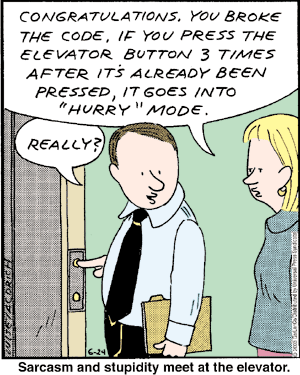
The always thoughtful vjack at Atheist Revolution brought up an interesting question on his blog awhile ago, and I'm paraphrasing, "Are we obligated to challenge stupidity, and if so, when?"

The "obligation" to challenge stupidity that vjack speaks of is from a Christopher Hitchens quote that he posts on his blog and I've posted here in a slightly longer form,

"Never be a spectator of unfairness or stupidity. Seek out argument and disputation for their own sake; the grave will supply plenty of time for silence. Suspect your own motives, and all excuses ..."

As vjack says, if we always challenged stupid claims by others, we'd have scant time for anything else in our days.  But that shouldn't dissuade us from doing so when we see fit. His query obviously comes from the atheist/skeptic community frame of reference, but it doesn't have to.

There are varying degrees of stupidity and for the criteria that determines whether one should respond.  Does my challenging this specific point really make a difference?  Am I being personally hurt by this person's stupidity?  Is their stupidity willful or is just borne of a lack of knowledge?

Obviously, the definition of stupid is important.  Stupid isn't merely someone who disagrees with us.  I believe it means to be willfully ignorant.  Knowing you are wrong but because of your prejudice or belief system, you close yourself off from fact.

That last item is where I get most upset. It's not that you don't know something. It's that you don't care ... those people that are not intellectually curious. Or it's that your worldview actively discourages you from seeking out answers. I have little problem with people that through having not been exposed to something before are ignorant. But I will challenge you to no end if you are content to stay in that state of ignorance. Being wrong is not a crime. Knowing you are and encouraging others to share in your delusions ... maybe that should be. This "willful" area, I believe, encompasses almost all religion.

"Faith is nothing more than the license religious people give themselves to keep believing when reasons fail." -- Sam Harris

Is it just being mean to call those of faith "stupid"? Maybe. Obviously "stupid" can't help but be taken pejoratively.  But I'm trying to be serious here.  I'm honestly trying to figure out why people believe certain ways and what keeps them from analyzing their own beliefs.

I can suffer a lot of ignorance daily, and mostly bear it well. While I don't consider myself an expert in my field (computers), I have quite a bit of experience, a pretty good memory and an ability to use the scientific method to troubleshoot issues. For these reasons, there are few things that I cannot solve. I don't always know the answer, but I'm not afraid to go out and find the answer.

"The hard but just rule is that if the ideas don’t work, you must throw them away. Don’t waste neurons on what doesn’t work. Devote those neurons to new ideas that better explain the data." -- Carl Sagan

In your fields of work, do you often feel compelled to challenge ignorance? Are you more prone to challenge it on non-work related issues? Are you more likely to challenge clients, strangers, co-workers, friends or family?

I try not to challenge clients ... for obvious reasons. What will it get me ... besides one less customer?  But, there are a few areas while I will even challenge them, just to name a few:  science denial, racism, sexism.

"What is it you most dislike? Stupidity, especially in its nastiest forms of racism and superstition." -- Christopher Hitchens, Hitch-22: A Memoir

What do you consider ignorance and how do you deal with it?


Saturday, April 06, 2013


Wednesday, February 09, 2011

Life Looks for Life - Carl Sagan


Life Looks for Life - Carl Sagan. Best viewed at YouTube at 720p.

"It’s better to light a candle than to curse the darkness." -– Carl Sagan


Saturday, November 13, 2010

Carl Sagan -- Happy Belated Birthday (11-9-1934)


I meant to put something up on his birthday but better late than never. For a curious child growing up in the Midwest, Carl Sagan was a rational breath of fresh air. He gave voice to that feeling inside me that things I heard were not quite right and that it was OK to question. Some of his better quotes:

"For me, it is far better to grasp the Universe as it really is than to persist in delusion, however satisfying and reassuring."

"Skeptical scrutiny is the means, in both science and religion, by which deep thoughts can be winnowed from deep nonsense."

"We live in a society exquisitely dependent on science and technology, in which hardly anyone knows anything about science and technology."

"The truth may be puzzling. It may take some work to grapple with. It may be counterintuitive. It may contradict deeply held prejudices. It may not be consonant with what we desperately want to be true. But our preferences do not determine what's true. We have a method, and that method helps us to reach not absolute truth, only asymptotic approaches to the truth — never there, just closer and closer, always finding vast new oceans of undiscovered possibilities. Cleverly designed experiments are the key."

"Who is more humble? The scientist who looks at the universe with an open mind and accepts whatever the universe has to teach us, or somebody who says everything in this book must be considered the literal truth and never mind the fallibility of all the human beings involved?"

"We are like butterflies who flutter for a day and think it's forever."

"The suppression of uncomfortable ideas may be common in religion and politics, but it is not the path to knowledge; it has no place in the endeavor of science."

"Those afraid of the universe as it really is, those who pretend to nonexistent knowledge and envision a Cosmos centered on human beings will prefer the fleeting comforts of superstition. They avoid rather than confront the world. But those with the courage to explore the weave and structure of the Cosmos, even where it differs profoundly from their wishes and prejudices, will penetrate its deepest mysteries."

Thursday, April 17, 2008

The Demon Haunted World


I'm finally wrapping up the reading of about a half dozen books that I've been in the middle of for months now. Over the next week or so, I'm going to provide my thoughts on each as I finish them. I have a really bad habit of getting myself in the middle of a bunch of books and then I get interested in something else. This has to end and I can't start anything new till I finish all of them. They include Godel, Escher, Bach: An Eternal Golden Braid, His Dark Materials by Phillip Pullman, I am America by Stephen Colbert, The Assault on Reason by Al Gore, Letter to a Christian Nation by Sam Harris and From Lucy to Language by Donald Johanson. The first that I'm going to quote a few highlight passages from is Carl Sagan's The Demon-Haunted World: Science as a Candle in the Dark. This is a very good book and analyzes the psychological and societal elements that force or allow people to believe in superstition, whether it be UFO's, new age religion, hallucinations, dreams or Christianity. Having been written a few years ago and not in the current relatively welcoming era of atheist tomes by Harris, Hitchens and Dawkins, Carl Sagan doesn't take on Christianity directly but it's obvious that he would have liked to. If there is a weakness to the book, it is that it spends entirely too much time on the psychology of UFO enthusiasts and not enough on that of Christians.

The following is from an essay on the "fine art of baloney detection". He listed some things to look for in politicians, religious people, media, or anybody that is trying to sell you something. Plus the list is useful for analyzing our own arguments:

In addition to teaching us what to do when evaluating a claim to knowledge, any good baloney detection kit must also teach us what not to do. It helps us recognize the most common and perilous fallacies of logic and rhetoric. Many good examples can be found in religion and politics, because their practitioners are so often obliged to justify two contradictory propositions. Among these fallacies are:

ad hominem -- Latin for "to the man," attacking the arguer and not the argument ...

argument from authority (e.g., President Richard Nixon should be re-elected because he has a secret plan to end the war in Southeast Asia -- but because it was secret, there was no way for the electorate to evaluate it on its merits; the argument amounted to trusting him because he was President: a mistake, as it turned out);

argument from adverse consequences (e.g., A God meting out punishment and reward must exist, because if He didn't, society would be much more lawless and dangerous -- perhaps even ungovernable.* Or: The defendant in a widely publicized murder trial must be found guilty; otherwise, it will be an encouragement for other men to murder their wives) ...

appeal to ignorance -- the claim that whatever has not been proved false must be true, and vice versa ... This impatience with ambiguity can be criticized in the phrase: absence of evidence is not evidence of absence.

special pleading, often to rescue a proposition in deep rhetorical trouble (e.g., How can a merciful God condemn future generations to torment because, against orders, one woman induced one man to eat an apple? Special plead: you don't understand the subtle Doctrine of Free Will.... God moves in mysterious ways.

begging the question, also called assuming the answer (e.g., We must institute the death penalty to discourage violent crime. But does the violent crime rate in fact fall when the death penalty is imposed? Or: The stock market fell yesterday because of a technical adjustment and profit-taking by investors -- but is there any independent evidence for the causal role of "adjustment" and profit-taking; have we learned anything at all from this purported explanation?);

observational selection, ... as the philosopher Francis Bacon described it, counting the hits and forgetting the misses ...

statistics of small numbers -- a close relative of observational selection (e.g., "They say 1 out of every 5 people is Chinese. How is this possible? I know hundreds of people, and none of them is Chinese ...

misunderstanding of the nature of statistics (e.g., President Dwight Eisenhower expressing astonishment and alarm on discovering that fully half of all Americans have below average intelligence);

inconsistency (e.g.,Attribute the declining life expectancy in the former Soviet Union to the failures of communism many years ago, but never attribute the high infant mortality rate in the United States (now highest of the major industrial nations) to the failures of capitalism ...

non sequitur -- Latin for "It doesn't follow" (e.g., Our nation will prevail because God is great. But nearly every nation pretends this to be true; the German formulation was "Gott mit uns"). Often those falling into the non sequitur fallacy have simply failed to recognize alternative possibilities;

post hoc, ergo propter hoc -- Latin for "It happened after, so it was caused by"

meaningless question (e.g., What happens when an irresistible force meets an immovable object? But if there is such a thing as an irresistible force there can be no immovable objects, and vice versa);

excluded middle, or false dichotomy -- considering only the two extremes in a continuum of intermediate possibilities (e.g., "Either you love your country or you hate it." Or: "If you're not part of the solution, you're part of the problem");

short-term vs. long-term -- a subset of the excluded middle, but so important I've pulled it out for special attention (e.g., We can't afford programs to feed malnourished children and educate pre-school kids. We need to urgently deal with crime on the streets. Or: Why explore space or pursue fundamental science when we have so huge a budget deficit?);

slippery slope, related to excluded middle (e.g., If we allow abortion in the first weeks of pregnancy, it will be impossible to prevent the killing of a full-term infant. Or, conversely: If the state prohibits abortion even in the ninth month, it will soon be telling us what to do with our bodies around the time of conception);

confusion of correlation and causation (e.g., A survey shows that more college graduates are homosexual than those with lesser education; therefore education makes people gay ...

straw man -- caricaturing a position to make it easier to attack (e.g., Scientists suppose that living things simply fell together by chance -- a formulation that willfully ignores the central Darwinian insight, that Nature ratchets up by saving what works and discarding what doesn't. Or -- this is also a short-term/long-term fallacy -- environmentalists care more for snail darters and spotted owls than they do for people);

suppressed evidence, or half-truths

weasel words (e.g., The separation of powers of the U.S. Constitution specifies that the United States may not conduct a war without a declaration by Congress. On the other hand, Presidents are given control of foreign policy and the conduct of wars, which are potentially powerful tools for getting themselves re-elected. Presidents of either political party may therefore be tempted to arrange wars while waving the flag and calling the wars something else -- "police actions," "armed incursions," "protective reaction strikes," "pacification," "safeguarding American interests," and a wide variety of "operations," such as "Operation Just Cause." Euphemisms for war are one of a broad class of reinventions of language for political purposes. Talleyrand said, "An important art of politicians is to find new names for institutions which under old names have become odious to the public").

Knowing the existence of such logical and rhetorical fallacies rounds out our toolkit. Like all tools, the baloney detection kit can be misused, applied out of context, or even employed as a rote alternative to thinking. But applied judiciously, it can make all the difference in the world -- not least in evaluating our own arguments before we present them to others.

It's kinda scary that you can witness pretty much all of these on a daily basis by watching a news conference by Dana Perino or the President.