Showing posts with label science. Show all posts

Wednesday, February 11, 2015

Saturday, April 06, 2013


Monday, September 17, 2012

The warp drive could be come science fact


From Space.com (Clara Moskowitz) and Discovery News:

"A warp drive to achieve faster-than-light travel -- a concept popularized in television's Star Trek -- may not be as unrealistic as once thought, scientists say. A warp drive would manipulate space-time itself to move a starship, taking advantage of a loophole in the laws of physics that prevent anything from moving faster than light. A concept for a real-life warp drive was suggested in 1994 by Mexican physicist Miguel Alcubierre, however subsequent calculations found that such a device would require prohibitive amounts of energy. Now physicists say that adjustments can be made to the proposed warp drive that would enable it to run on significantly less energy, potentially bringing the idea back from the realm of science fiction into science ..."

See more of the story here.

That's part of the wonder of science ... when the line between science and science fiction starts to blur.  I love the closing quote of the article:

"If we're ever going to become a true spacefaring civilization, we're going to have to think outside the box a little bit, we're going to have to be a little bit audacious,"

It's that lack of audacity that is preventing us from solving the world's problems.  We have possible solutions to things like hunger, global warming, energy and space travel but small, superstitious minds rule the day.  Respecting other people's right to their own belief systems is fine and dandy, but not at the expense of progress.  And the argument that religion is useful for promoting morality is laughable.  You cannot go a day without hearing of religion encouraging killing and hate and bigotry.

Let's be audacious and use rationality and reason.

Friday, July 20, 2012

The Higgs Boson, AKA the God Particle, Explained with Animation


Yeah, that clears it all up for me. Now I understand perfectly. Or not. The animation does help, though. I'm no brain surgeon but I have taken quite a bit of college calculus, chemistry and calculus-based physics. I've read Brian Greene and Feynman. I'm not a complete moron, but still it is a little tough to picture things that make electrons look huge in comparison.

Friday, March 30, 2012

... and yet it moves

"Eppur Si Muove" -- "And yet it moves" -- words often attributed to Galileo when he was forced to recant prior to the Inquisition. He may or may not have actually said them, but the point is salient regardless. He was describing the movement of the Earth around the Sun, a configuration that the Church did not want to concede as it would shatter their world view. Whether the Church wanted the Earth to be the center of the universe or not, it doesn't really change the facts. Maybe Galileo wouldn't have been so quick with a comeback if he had been given the "comfy chair" torture:


As is often the case, history repeats itself, and we have reached a point (at least in America) where a segment of the country feels their belief system crumbling and lashes out at those things that call it into question. Whether it is fighting the teaching of evolution in our classrooms(by putting creationism on equal footing, like in Tennessee) or the denial of climate change, some (and you know who you are) are exerting an all-out assault on science and reason.

Evolution and climate change may not be convenient to your idealogy, but it doesn't lessen their validity. As Neil DeGrasse Tyson once said,

"The good thing about science is that it's true whether or not you believe in it."

It's not a fair fight. Scientific progress, by its very nature, works on the assumption that all involved parties that are in disagreement are still respectful and are desirous of using reason to resolve that disagreement. Deniers, however, do not. Innuendo, out of context cherry picking of data and ad hominem attacks are all tools that they will use. Scientists will not and cannot use these same tools. It's like carrying a knife to a gun fight, as it were. Climatologist Michael Mann, on a recent NPR Science Friday broadcast (March 2, 2012) explores this issue.

Wunelle shared a great video from this last weekend's Reason Rally. In the video Adam Savage (of MythBusters) gives a short, straightforward account of what reason means in our daily lives. To simply drive a car, fly on a plane, use a computer ... you are relying on hundreds of years of theory, research and experimentation by scientists, mathematicians and engineers. It's not magic. The very people that rail against scientists, that stunt our children by fighting against real science and promoting religion and pseudo-science -- these people have no problem taking advantage of those technologies that are utterly dependent on science.

I propose that all that have a problem with the teaching of science and with the use of reason stop using the fruits of those things. The way I see it, unless you are living in some Quaker or Amana colony driving around in a horse-drawn carriage and spurning the use of technology, you are a fucking hypocrite.

Earlier I said that "some" were against science. That "some" is obviously largely conservatives and most notably the the religious among them. Why this group, that I believe is more vocal than actually large, gets such a prominent place in public discourse - I will never know. But, it is our responsibility as thinking beings to challenge the superstitious and ignorant. As Lawrence Krauss recently said,

" ... Choosing to censor or distort knowledge rather than risk the possibility that such knowledge, or the technologies that result from it, might challenge faith or confront preexisting ideological biases is a something that should better characterize the Taliban or al Qaeda rather than the Republican Party.

As we head into the home stretch of a too-long presidential primary season, it is not too late for the public to turn their back on candidates that turn their back on empirical reality and scientific progress."

When seeing a speech by Rick Santorum, one feels that some elaborate joke is being played on us. This is all just a modern day Monty Python sketch. But it's not and the gravity of the situation takes some of the fun out of it. If we don't fight against this revisited Inquisition, then we will have no one to blame but ourselves for what will become of our society.

Saturday, March 17, 2012

Podcast(s) of the Week

This week, I'm highligting two podcasts, one from This Week in Science and the second from Philosophy Bites:

This Week in Science, Feb 02, 2012:


An interview with Shawn Lawrence Otto, author of Fool Me Twice: Fighting the Assault on Science in America is the highlight of this podcast. In contrast with a similar recent book by Chris Mooney, The Republican War on Science, Otto's book gets into how politicians, in general, seems unwilling to debate issues of science openly. When it is less controversial to hold a public debate on religion than one on science, you know something is fucked up with society.

I have not read either of Otto's or Mooney's books, but they're on my want list. It seems to me that Otto's would be the better for a general audience.

During the interview, Otto also mentioned The Debunking Handbook. This is a 7 page PDF file that you can download here. The Handbook is a good read and is a nice tool when you are debating with purveyors of pseudo-science (Creationists, climate change deniers, etc.).

Beyond Otto's interview, the podcasts has some interesting discussions on the psychology of Facebook posts and the nature of contagious yawns. The podcast runs about an hour.

------------------------------------------------------------------------

From Philosophy Bites, Ronald Dworkin, American philosopher and constitutional law scholar, on the "Unity of Value -- Is liberty compatible with equality?"


This is a very good discussion on the practical applicability of philosophical concepts like liberty and equality. Dworkin contends there is a "right answer" to societal problems. Despite what politicians lead you to believe, liberty and social equality are not mutually exclusive.

He says that you can't look in the dictionary for a philosophical definition. You have to be able to apply your concept to the people that are affected by it. We have to "justify what we do in their name" and there can't be a disconnect between theory and action.

The discussion is about 19 minutes.

Monday, March 05, 2012

Podcast of the week

"It is the province of knowledge to speak, and it is the privilege of wisdom to listen." -- Oliver Wendell Holmes


I'm in the car a lot. Honestly, a ridiculous amount of time. And I've ran the course on sports talk radio. You can only listen to local sports meatballs complaining about stuff they have absolutely no knowledge of for so long. Ideally, I'd listen to NPR all the time but a lot of the shows I like aren't on when I'm driving around. So, for the last year I've been on a huge podcast listening kick. My car stereo has an auxiliary port so that I can plug my Blackberry into it. Plus, I've gotten in the habit of walking 3 or 4 miles each night, so I'll put a bunch of podcasts on the Blackberry and tool around the neighborhood in bliss.

Since I don't have near the amount of time I'd like to read, I've found listening to the podcasts gives me an opportunity to still learn and keep up on films, music, history, science, philosophy, etc. This week, I'm just going to the give you the general sites for the podcasts that I most often download. But, in future weeks (and every week, I hope), I will highlight 3 or 4 specific podcasts that I've listened to that I thought might be of interest to my few readers.

Anyway, here we go:

Filmspotting -- Put on by a couple of Chicago film geeks, these podcasts are frequently over an hour long. They review new movies, but maybe not the blockbusters that most other reviewers waste time on. These are actual good movies that may not get pub from mainstream reviewers. Plus, their shows have themed topics, such as Top 5 Action Thespians, which I just listened to a couple of days ago. Michael Phillips makes frequent appearances as do many indie filmmakers. While they get into a bit of film theory, it's not necessarily all high-brow and a casual film watcher can still get something out of it.


The Naked Scientists -- I like listening to this with my son. It's a British show that explores current science topics in-depth, often interviewing leading scientists. But, it doesn't get too overly technical, so is good for an audience of all ages. Plus, they bring some humor into it.


Nerdist - Hosted by comedian Chris Hardwick. Very irreverent and often off-color, but Hardwick has channelled many years in the entertainment business and his natural inquisitiveness and nerdiness into relationships with a lot of science and sci-fi talent. This is just a sampling of the guests on his podcasts in the past year: Conan O'Brien, David Tennant (Doctor Who), J.J. Abrams, Neil deGrasse Tyson, the cast of Big Bang Theory, Sir Patrick Stewart, etc.

NPR's Fresh Air -- This is probably my favorite NPR show. Terry Gross is arguably the best interviewer in any medium and has been doing it for over 30 years. She'll interview people from just about any area: politicians, actors, scientists, authors, etc.

NPR's All Songs Considered -- I'm relatively new to this podcast but have been very impressed. As their website says, "All Songs Considered is a great place to discover new music that doesn't get a lot of airplay anywhere else.". They will focus on a specific genre each broadcast and give some play to musicians that you may not have heard of but that are fantastic. One week it might be electonic music, another week punk, and yet another week might be themed.

Philosophy Bites -- If you like philosophy, this is really good. They highlight a specific philosophical concept on each podcast and will talk to a philosopher well-versed in that particular topic. The shows are not too long, frequently about 15 minutes. A few topics from the last year: meaning of life, moral relativism, atheism, Hume on design, humanism, free will. Good stuff.

NPR's Science Friday -- If you listen to NPR, most of you will know what this is. Ira Flatow has hosted this couple hour program on current science topics on every Friday (obviously) for as long as I can remember. I was lucky enough to see Ira Flatow in person a few years back at one of the ASU Origins Symposiums that I attended. He's very knowledgeable and understands the relevance and for science and reason in our everyday lives.


Sierra Club Radio - As you would guess, this highlights current environment topics, often speaking with authors and activists. About a half long episodes.


Sound on Sight - Another in-depth movie analysis program of about an hour an episode.

Star Talk Radio -- One of my favorites. This is hosted by astrophysicist Neil deGrasse Tyson. I believe he is one of the best science popularizers out there and a tireless advocate for science education and space exploration.

These are just a few of the podcasts available. There are zillions of other smart people making great podcasts. All of these can be found through Itunes or the pages I linked to above. Itunes is probably the best place for searching for podcasts of a specific topic.

The best stuff, the most informative talk, the most intelligent insights ... are not on your TV's. What you see on most television is what someone is paying for you to see or that is trying to sell something. Obviously reading books is probably the best way of getting information, but sometimes that verbal interaction between smart people is great way of learning. And I still want to be learning even when I can't be sitting down reading a book. Listening to something of substance makes me feel like that dead time in a car wasn't a complete waste of my time.

"I like to listen. I have learned a great deal from listening carefully. Most people never listen." -- Ernest Hemingway

Wednesday, January 11, 2012

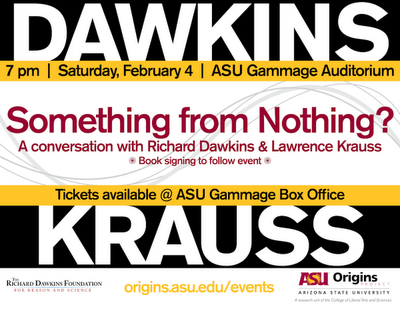
Something from Nothing?

Yes, I'm cool. Admit it. I'm getting to see Richard Dawkins for the 3rd time! Plus, Lawrence Krauss. I'm going to wait around to get Mr. Dawkins to sign one of my books this time.


Wednesday, August 17, 2011

Look up ... not down

A nice response to those that would cut funding to NASA:


Neil deGrasse Tyson is one of my favorite science popularizers and a worthy warrior against the rampant anti-intellectualism of today.

"I don't want students who could make the next major breakthrough in renewable energy sources or space travel to have been taught that anything they don't understand, and that nobody yet understands, is divinely constructed and therefore beyond their intellectual capacity. The day that happens, Americans will just sit in awe of what we don't understand, while we watch the rest of the world boldly go where no mortal has gone before." -- Neil deGrasse Tyson


Saturday, July 16, 2011

Things I like: Science Popularizers

I like science without having to be convinced to like it. But I'm not necessarily the common audience. That's why I'm a big fan of those scientists and authors that are able to 1) bring science down to the level of the non-scientist without being condescending and 2) make it interesting in the process.

I grew up in the age of one of the best science popularizers ever, Carl Sagan. His knowledge of physics and astronomy was perhaps only exceeded by his enthusiasm for the same. He made it semi-cool for a nerdy kid to run around saying "billions and billions". OK, even he couldn't have made me cool. But at least I was interested in science.


As I got older, others including Stephen Hawking became popular. When my wife, who could not care less about science, is aware of a scientist like Hawking, then you know someone has entered pop culture.

Despite the obvious anti-intellectualism that seems rampant in society, I still think we are in the heyday of science popularizers and that gives me hope. And maybe we are not as anti-science as it appears. There is a very vocal segment of society (much of Congress, all of FOX News) that has a high moral regard for the Dark Ages, but maybe they are just a loudmouth minority and don't represent most of society. That is what I hope.

If society is going to be brought back from the brink, minds such as these will play a big part:

Brian Cox, broadcaster, musician and physicist
Paul Davies, physicist, author and broadcaster
Richard Dawkins, evolutionary biologist and author
Daniel Dennett, philosopher and cognitive scientist
Jared Diamond, evolutionary biologist, physiologist, biogeographer and author
Brian Greene, physicist
Stephen Hawking, theoretical physicist and author
Christopher Hitchens, author, journalist and essayist
Jamie Hyneman, special effects artist and television personality (MythBusters)
Lawrence Krauss, physicist and author
Robert Krulwich, broadcaster
Bill Nye, broadcaster and mechanical engineer, known as the "Science Guy"
Steven Pinker, experimental psychologist, cognitive scientist and author
Adam Savage, special effects artist and television personality (MythBusters)
Neil deGrasse Tyson, astrophysicist and author
... and many others


I've had the fortune to have seen a couple of them in person, Richard Dawkins, Paul Davies, and Lawrence Krauss (and spoke to Krauss).

What makes many of them so relevant is not their knowledge, but their willingness and ability to use that knowledge to educate. Please don't get me wrong. I don't anyone to have to dumb themselves down. But, let's be honest ... if people like Hawking and Greene were to talk to us as they speak to each other, they might as well be speaking ancient Greek. And this is coming from someone who took 5 college level calculus courses, calculus-based physics, and astrodynamics.

deGrasse Tyson, for one, is funny and very active on the talk-show circuit, having appeared on the Daily Show and Colbert repeatedly, plus he has podcasts and a PBS show called Nova Science Now that I regularly watch with my son. Just yesterday he was on Jimmy Fallon:


Pointy-headed academicians are not going to be the ones that convince Joe Schmoe of the dangers of climate change, the importance of pure research, and why we should continue the space program. It will be through people like deGrasse Tyson that sway the common man with humor and a sense of awe. One can hope that a sense of wonder will replace fear and mysticism. We'll see.


Thursday, July 07, 2011

Quantum Typography


Courtesy of Garry Tan at garry's visualposterous

Tuesday, January 25, 2011

Great Debate: What is Life? at ASU

Awesome! I'm going to get to see Richard Dawkins speak in person again ... this time from the front row.


"Join a panel of renowned scientists and public intellectuals, including evolutionary biologist Richard Dawkins, human genome sequencer J. Craig Venter, Nobel Laureate molecular biologist Sidney Altman, NASA astrobiologist Chris McKay, Nobel Laureate biologist Lee Hartwell, and renowned physicist Paul Davies as they discuss some of the most profound questions in science today: What is life? When, where, and how did life begin? Can and should we create life in the laboratory?"

Saturday, November 13, 2010

Carl Sagan -- Happy Belated Birthday (11-9-1934)


I meant to put something up on his birthday but better late than never. For a curious child growing up in the Midwest, Carl Sagan was a rational breath of fresh air. He gave voice to that feeling inside me that things I heard were not quite right and that it was OK to question. Some of his better quotes:

"For me, it is far better to grasp the Universe as it really is than to persist in delusion, however satisfying and reassuring."

"Skeptical scrutiny is the means, in both science and religion, by which deep thoughts can be winnowed from deep nonsense."

"We live in a society exquisitely dependent on science and technology, in which hardly anyone knows anything about science and technology."

"The truth may be puzzling. It may take some work to grapple with. It may be counterintuitive. It may contradict deeply held prejudices. It may not be consonant with what we desperately want to be true. But our preferences do not determine what's true. We have a method, and that method helps us to reach not absolute truth, only asymptotic approaches to the truth — never there, just closer and closer, always finding vast new oceans of undiscovered possibilities. Cleverly designed experiments are the key."

"Who is more humble? The scientist who looks at the universe with an open mind and accepts whatever the universe has to teach us, or somebody who says everything in this book must be considered the literal truth and never mind the fallibility of all the human beings involved?"

"We are like butterflies who flutter for a day and think it's forever."

"The suppression of uncomfortable ideas may be common in religion and politics, but it is not the path to knowledge; it has no place in the endeavor of science."

"Those afraid of the universe as it really is, those who pretend to nonexistent knowledge and envision a Cosmos centered on human beings will prefer the fleeting comforts of superstition. They avoid rather than confront the world. But those with the courage to explore the weave and structure of the Cosmos, even where it differs profoundly from their wishes and prejudices, will penetrate its deepest mysteries."

Monday, September 27, 2010

Dark Ages


Having Netflix Instant, I've been working through some programs and movies that I might not have watched otherwise. One of those programs is Stargate SG-1. I had seen random episodes through the years but had not watched a whole season. I liked the show but just didn't take the time to follow it. Anyway, I saw an episode (called Enigma in season 1 that had a line that I found interesting:

We'd be colonizing space right now if it hadn't been for the Dark Ages. There was a period of over eight hundred years where science was heresy and anathema. Maybe they didn't have that set-back.” – Daniel Jackson on the reason for the Tollan’s superior tech.

The SG-1 team had found a human society that appeared to be at least 500 years advanced of ours despite the fact that their humans had originated on Earth (and thus should be no more advanced). Dr. Jackson was commenting on the reason for Earth society's stunted scientific growth. The quote is interesting for a couple of reasons. First of all, is it true? I believe so. Given an additional 500 or 600 more years, imagine the advancements in propulsion, computing, physics, etc. (assuming we haven't destroyed ourselves).

That's the fascinating thing about science fiction. Sci-fi poses questions about life in an entertaining way and broaches subjects that would seem controversial or preachy in another context. Stargate is by no means on the level of Battlestar Gallactica as far as relevance is concerned. But, in its own way, it didn't do too bad in that department.

The quote is interesting for another reason. Does it say something about the current state of science and religion? Are we working towards a modern Dark Age? There is rampant anti-intellectualism. Anyone that dares to to doubt the existence of God is pilloried. Science that doesn't agree with someone's worldview is dismissed. People of influence and power in our government and media make quotes such as these:

Rush Limbaugh: "Despite the hysterics of a few pseudo-scientists, there is no reason to believe in global warming."

Senate candidate Christine O'Donnell on Bill Maher's show:

O’DONNELL: You know what, evolution is a myth. And even Darwin himself –

MAHER: Evolution is a myth?!? Have you ever looked at a monkey!

O’DONNELL: Well then, why they — why aren’t monkeys still evolving into humans?


And on FOX News: "They are — they are doing that here in the United States. American scientific companies are cross-breeding humans and animals and coming up with mice with fully functioning human brains. So they're already into this experiment."

And the always entertaining James Inhofe, global-warming denier par excellence:

" ... much of the debate over global warming is predicated on fear, rather than science. I called the threat of catastrophic global warming the "greatest hoax ever perpetrated on the American people,""

"I don't have to tell you about reading the Scriptures, but one of mine that I’ve always enjoyed is Romans 1, 22 and 23. You quit worshipping God and start worshipping the creation -- the creeping things, the four-legged beasts, the birds and all that. That’s their (the environmentalists') god. That’s what they worship. If you read Romans 1:25, it says, ‘and they gave up their God and started worshipping the creation.’ That's what we are looking at now, that’s what’s going on. And we can’t let it happen."


As Cincinnati columnist Ben L. Kaufman put it,

"In a nation accustomed to seeking simple answers to complex questions and a culture increasingly driven by belief rather than evidence, scientists today often are trying to communicate with the willfully deaf."

Something to think about. If rationality and reason are constantly subverted while belief and mysticism are elevated, are we diving headlong into another age of stifled development? Can our society survive another dark age?

"Science can teach us, and I think our own hearts can teach us, no longer to look around for imaginary supports, no longer to invent allies in the sky, but rather to look to our own efforts here below to make this world a fit place to live in, instead." -- Bertrand Russell


Sunday, June 06, 2010

Framing ignorant vs. educated as a debate

Great New Rules segment by Bill Maher a few days ago.  The good stuff is at about the 2:20 point on in the clip.


Watch New Rules 6/4/10 in Entertainment  |  View More Free Videos Online at Veoh.com

"That's the problem with our obsession with always seeing two sides of every issue equally -- especially when one side has a lot of money. It means we have to pretend there are always two truths, and the side that doesn't know anything has something to say. On this side of the debate: Every scientist in the world. On the other: Mr. Potato Head.

There is no debate here -- just scientists vs. non-scientists, and since the topic is science, the non-scientists don't get a vote. We shouldn't decide everything by polling the masses. Just because most people believe something doesn't make it true. This is the fallacy called argumentum ad numeram: the idea that something is true because great numbers believe it ...

... Media, could you please stop pitting the ignorant vs. the educated and framing it as a "debate." The other day, I saw a professor from the Union of Concerned Scientists face off against a distinguished expert on Tea Partying, whose brilliant analysis, recently published in the New England Journal of Grasping at Straws, was that we shouldn't teach climate science in schools because kids find it scary. As they should. I hope they're peeing in their pants.

The last decade, year, and month are all the hottest on record. Then there's the killing of the oceans, floods, Category 5 hurricanes, heat waves, giant wild fires, and the vanishing water supply. You know, the little things. And yet deniers say, it's just a theory. As is gravity. For progress to happen, certain things have to become not an issue anymore, so we can go on to the next issue. Evolution was an issue until overwhelming consensus among scientists made it not an issue ..."

"I much prefer the sharpest criticism of a single intelligent man to the thoughtless approval of the masses." -- German astronmer Johannes Kepler

Wednesday, May 12, 2010

Book Review: why does E=mc2 by Brian Cox & Jeff Forshaw


Possessing a fairly technical background -- engineering degree, college calculus and calculus-based physics -- I'm not completely lost when I read science books. Still, I'm 20 years removed from college and have not found a lot of cause to use any of that. And brain cells are readily killed by lack of use and beer.

So, when I heard of why does E=mc2? on the Daily Show and I read its cover promising, "the most accessible, entertaining and enlightening explanation of the best-known physics equation in the world ...", I was encouraged. The following excerpt from the book does a good job of confirming my optimism:

"the provocation lies in the way the science challenges us to think
about the world around us
. Scientist or not, each of us has intuition and we all infer things about the world from our everyday experiences. If we subject our observations to the cold and precise light of the scientific method, however, we often discover that nature confounds our intuition. As this book unfolds, we will discover that when things whiz about at high speeds, common-sense notions regarding space and time are dashed and replaced by something entirely new, unexpected, and elegant. The lesson is a salutary and humbling one, and it leaves many scientists with a sense of awe: The universe is much richer than our everyday experiences would have us believe. Perhaps most wonderful of all is the fact that the new physics, for all its richness, is filled with a breathtaking mathematical elegance.

... science at its heart is not a complicated discipline. ... it is an attempt at removing our innate prejudices in order to observe the world as objectively as possible. It may be more or less successful in that goal but few can doubt its success in teaching us how the universe “works.” The really difficult thing is to learn not to trust what we might like to think of as common sense. By teaching us to accept nature for what it is, and not for what our prejudice may suggest that it should be, the scientific method has delivered the modern technological world. In short, it works."

That's part of the strength of this book - It gives a general perspective on the role and scope of science while explaining a specific concept. I guess that helps to make it less of a dry and scholarly tome.

The basic thing to take from the theory of relativity is that mass and energy are interchangeable. Also, space and time are not not mutually exclusive entities but rather interwoven ones. Our observations of each are dependent on our location and our speed. That may seem abstract, but it has been experimentally proven. If the variations of time predicted by Einstein were not taken into account, the GPS system in your car would not work. "Time ticks at a different rate on the orbiting satellites than it does on the ground."

That's the big kicker. People could not get through a single day without using technology that has been developed using science, and theory, and experimentation. Though, many would pretend they are not and would deny science and would seek to deny others from using it.

Science does not revel in perpetuating myth, but rather in destroying it: "Science is at its heart a modest pursuit, and this modesty is the key to its success. Einstein’s theories are respected because they are correct as far as we can tell, but they are no sacred tomes. They will stand, to put it bluntly, until something better comes along. Likewise the great scientific minds are not revered as prophets but as diligent contributors to our understanding of nature. There are certainly those whose names are familiar to millions, but there are none whose reputations can protect their theories from the harsh critique of experiment. Nature is no respecter of reputations."

Besides the previously mentioned technology that relies on an understanding of E=mc2, there are experiments going on right now that will further our understanding of the nature of particles and will perhaps lead to an even better understanding of the nature of our universe. If you want to know that they are trying to do and what they are trying to find at the Large Hadron Collider, I would suggest you read this book and, perhaps, Particle Physics – A Very Short Introduction by Frank Close, as reviewed very well by Cyberkitten.

I liked this book quite a bit. It's not a book filled with equations. But don't kid yourself. When they say "accessible", they are stretching it a bit. There is still a lot of talk about "Minkowski spacetime", the "Higgs field", quarks and gluons. But any reasonably clever person can read this book and get a better handle on relativity.

Note: For anyone that might want to download this book to their PC or book reader, I found a full PDF version at: why does E-mc2?

Wednesday, July 29, 2009

Poll: Just six percent of scientists are Republican

"I do not feel obligated to believe that the same God who has endowed us with sense, reasons, and intellect has intended us to forgo their use." -- Galileo Galilei


This may be the least shocking news ever:

A full 87 percent of American scientists see their political alignment as Democrat or Independent, according to a new Pew Research poll.

Surprisingly or not, just six percent declared themselves Republican, and only nine percent overall expressed support of conservative ideology.


From the data summary:

Most Americans do not see scientists as a group as particularly liberal or conservative. Nearly two-thirds of Americans (64%) say they think of scientists as “neither in particular”; 20% see them as politically liberal and 9% say they are politically conservative.

In contrast, most scientists (56%) perceive the scientific community as politically liberal; just 2% think scientists are politically conservative. About four-in-ten scientists (42%) concur with the majority public view that scientists, as a group, are neither in particular.

The scientists’ belief that the scientific community is politically liberal is largely accurate. Slightly more than half of scientists (52%) describe their own political views as liberal, including 14% who describe themselves as very liberal. Among the general public, 20% describe themselves as liberal, with just 5% calling themselves very liberal.

These figures should only be surprising to someone who neglected current events during the Bush administration, which was accused of censoring and intimidating scientists on matters from global warming to medical research and nuclear weapons.

It's safe to say that being treated like an unwanted step-child, along with continued, eye-widening nonsense like this, has not engendered much love of Republicanism in the scientific community.

-- Stephen C. Webster

The aw-shucks anti-intellectualism of the past 8 years has done incredible damage that will take years to recover from. The thing is, it doesn't have to be this way. And it hasn't always been that way. Teddy Roosevelt was one of our most environmental presidents, promoting conservation of natural resources. Dwight Eisenhower started the space race.

If the goal of your poltical party is to stick your head in the ground and to keep people stupid, then I can't believe you will have a lot of staying power. If you have a valid idealogy, you defeat arguments with better arguments, not by suppressing facts.

The mistakes that Republicans are making now will haunt them for a generation. And those so-called Blue Dog Democrats, DINO's (Democrat in Name Only) will face the same problem.

You can't ignore the scientific facts that are slapping you in the face when you are making laws that affect all of us. Republicans and a large percentage of the public think there is scientific debate over evolution or global warming, when there is not.

We are never going to solve the world's problems by denying they exist.


"Reason and free inquiry are the only effectual agents against error." -- Thomas Jefferson


Friday, August 22, 2008

Science Fiction?


Science close to unveiling invisible man
Jonathan Leake, Science Editor


Invisibility devices, long the realm of science fiction and fantasy, have moved closer after scientists engineered a material that can bend visible light around objects.

The breakthrough could lead to systems for rendering anything from people to large objects, such as tanks and ships, invisible to the eye – although this is still years off.

Researchers at the University of California at Berkeley, whose work is funded by the American military, have engineered materials that can control light’s direction of travel. The world’s two leading scientific journals, Science and Nature, are expected to report the results this week.

It follows earlier work at Imperial College London that achieved similar results with microwaves. Like light, these are a form of electromagnetic radiation but their longer wave-length makes them far easier to manipulate. Achieving the same effect with visible light is a big advance.

Underlying the work is the idea that bending visible light around an object will hide it.

Xiang Zhang, the leader of the researchers, said: “In the case of invisibility cloaks or shields, the material would need to curve light waves completely around the object like a river flowing around a rock.” An observer looking at the cloaked object would then see light from behind it – making it seem to disappear.

Substances capable of achieving such feats are known as “meta-materials” and have the power to “grab” electromagnetic radiation and deflect it smoothly. No such material occurs naturally and it is only in the past few years that nano-scale engineering, manipulating matter at the level of atoms and molecules, has advanced sufficiently to give scientists the chance to create them.

The tiny scale at which such researchers must operate is astonishing in itself. Zhang’s researchers had to construct a material whose elements were engineered to within about 0.00000066 of a metre.

The military funding that Zhang has won for his research shows what kind of applications it might be used for, ushering in a new age of stealth technology.

I really dig when the science reality of now approaches the science fiction of my youth. An amazing amount of stuff many thought of as far-fetched then seem eerily prescient. The next 50 to 100 years should be exciting as long as we don't destroy ourselves or our planet.

It is sad that some of the most exciting advances come about because of a perceived military need.

"O divine art of subtlety and secrecy! Through you we learn to be invisible, through you inaudible and hence we can hold the enemy's fate in our hands." -- Sun Tzu


Sunday, August 10, 2008

Just Finished Reading: The World Without Us by Alan Weisman


This is, quite simply, one of the most important books I've read in years. It's the kind of book that you'd recommend to your friends that aren't necessarily environmental. They may not be going in, but I'd be surprised if they didn't have a different viewpoint after reading the book.

The central concept of The World Without Us is what would happen to the planet if, in an instant, all humans disappeared. As Weisman says in the Acknowledgments of the book:

"It was a deceptively simple question that ... lets us view our Earth's current myriad stresses from the disarming vantage of a fantasy in which we supposedly no longer exist, yet somehow we get to watch what unfolds net. Watch, and maybe learn ..."


Through exhaustive research and interviews with experts in many fields: architecture, geology, biology, zoology, archaeology, etc., Weisman has created a unique thought experiment that shows how destructive we've been (and will continue to be beyond our demise), but also how quickly the earth would eat up signs of civilization. He goes all over the planet - downtown New York (with scenes reminiscent of I am Legend), the oil fields of Texas, the cradle of life in Africa, etc.

It's an idea that is not that far-fetched. Seemingly successful cultures in our past have mysteriously disappeared:

"When you examine societies just as self-confident as ours that unraveled and were eventually swallowed by the jungle, you see that the balance between ecology and society is exquisitely delicate. If something throws that off it can all end. Two thousand years later, someone will be squinting over the fragments, trying to find out what went wrong." -- Archaeologist Arthur Demarest

It's a fascinating, yet scary, book that packs in a bunch of science but not so much that the lay person couldn't understand it. And it's so well-written that it reads more like fiction than dry history. If you want to give someone a different perspective on the ways in which we affect our planet without beating them over the head with environmentalism, recommend this book.

Thursday, February 08, 2007

Bodyworlds


We were lucky enough to check out the Bodyworlds 3 exhibit at the Arizona Science Center last night. For those of you who haven't heard of it, it's a traveling exhibition of real bodies that have been preserved through the process of Plastination. They are posed in creative and artistic poses and show various parts of the body. It's very cool and educational and despite how some newscasters portrayed it, it didn't gross me out at all. It prompted a lot of questions by Alex and I think it was a great learning experience for him.

Seeing real organs and muscles outside the confines of a flat textbook and seeing cross-sections of diseased organs allows a person to visualize much easier the effects of smoking and drinking.

Religious or not, what do you think about the sanctity of the human body after death? Is it desecration? The people whose bodies were preserved knowingly donated them for the very purpose. When I told my mom that we had went, I got a funny (odd) response. She's not religious at all and considers herself an agnostic/atheist but she said that she probably couldn't go to a show like that because she just gets an odd feeling around dead bodies. Almost like she senses an aura or force. She's probably just nutty (and I would know) but is there any truth to that? Could there be a presence unique to a person that isn't necessarily tied to religion? I don't think so, but what do I know?

"We all die. The goal isn't to live forever, the goal is to create something that will." -- Chuck Palahniuk (author of Fight Club)