Showing posts with label christopher hitchens. Show all posts

Sunday, August 04, 2013

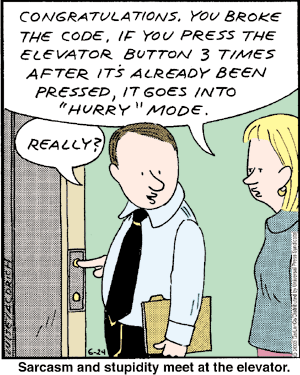
Challenging Stupidity


The always thoughtful vjack at Atheist Revolution brought up an interesting question on his blog awhile ago, and I'm paraphrasing, "Are we obligated to challenge stupidity, and if so, when?"

The "obligation" to challenge stupidity that vjack speaks of is from a Christopher Hitchens quote that he posts on his blog and I've posted here in a slightly longer form,

"Never be a spectator of unfairness or stupidity. Seek out argument and disputation for their own sake; the grave will supply plenty of time for silence. Suspect your own motives, and all excuses ..."

As vjack says, if we always challenged stupid claims by others, we'd have scant time for anything else in our days.  But that shouldn't dissuade us from doing so when we see fit. His query obviously comes from the atheist/skeptic community frame of reference, but it doesn't have to.

There are varying degrees of stupidity and for the criteria that determines whether one should respond.  Does my challenging this specific point really make a difference?  Am I being personally hurt by this person's stupidity?  Is their stupidity willful or is just borne of a lack of knowledge?

Obviously, the definition of stupid is important.  Stupid isn't merely someone who disagrees with us.  I believe it means to be willfully ignorant.  Knowing you are wrong but because of your prejudice or belief system, you close yourself off from fact.

That last item is where I get most upset. It's not that you don't know something. It's that you don't care ... those people that are not intellectually curious. Or it's that your worldview actively discourages you from seeking out answers. I have little problem with people that through having not been exposed to something before are ignorant. But I will challenge you to no end if you are content to stay in that state of ignorance. Being wrong is not a crime. Knowing you are and encouraging others to share in your delusions ... maybe that should be. This "willful" area, I believe, encompasses almost all religion.

"Faith is nothing more than the license religious people give themselves to keep believing when reasons fail." -- Sam Harris

Is it just being mean to call those of faith "stupid"? Maybe. Obviously "stupid" can't help but be taken pejoratively.  But I'm trying to be serious here.  I'm honestly trying to figure out why people believe certain ways and what keeps them from analyzing their own beliefs.

I can suffer a lot of ignorance daily, and mostly bear it well. While I don't consider myself an expert in my field (computers), I have quite a bit of experience, a pretty good memory and an ability to use the scientific method to troubleshoot issues. For these reasons, there are few things that I cannot solve. I don't always know the answer, but I'm not afraid to go out and find the answer.

"The hard but just rule is that if the ideas don’t work, you must throw them away. Don’t waste neurons on what doesn’t work. Devote those neurons to new ideas that better explain the data." -- Carl Sagan

In your fields of work, do you often feel compelled to challenge ignorance? Are you more prone to challenge it on non-work related issues? Are you more likely to challenge clients, strangers, co-workers, friends or family?

I try not to challenge clients ... for obvious reasons. What will it get me ... besides one less customer?  But, there are a few areas while I will even challenge them, just to name a few:  science denial, racism, sexism.

"What is it you most dislike? Stupidity, especially in its nastiest forms of racism and superstition." -- Christopher Hitchens, Hitch-22: A Memoir

What do you consider ignorance and how do you deal with it?


Monday, June 04, 2012

Hitchens Tribute

I was not lucky enough to have met Christopher Hitchens, but have, on a couple of occasions, met and spoken to the great Lawrence Krauss. Krauss was lucky (as he would admit himself) to be considered a friend of Hitchens. Here is a remarkable tribute to Hitchens that Krauss gave at the 2012 Global Atheist Convention:


Thursday, December 15, 2011

Christopher Hitchens: 1949 -2011


A uniquely intelligent and witty man who informed many of my opinions of the last few years. In a time of anti-intellectual pride, he was not afraid to truly think about things.

And as he predicted and hoped, there was no deathbed conversion. He died as he lived, seeking truth.

He will be missed. I will miss him.

Monday, October 10, 2011

I’m not going to quit until I absolutely have to

Showing his usual wit, but also a dignity and grace that I'm sure I wouldn't have if I were in his position, Christopher Hitchens accepted an award from Richard Dawkins at the Atheist Alliance of American Convention in Texas recently. This speech is his direct acceptance of that award (but also check out the other two videos here)


It saddens me to know that we will not have too many more of his speeches to enjoy. But it also heartens me to know that even at the end, he sticks to his convictions and does not give in to fear over logic. Because, and he knows this well, his contributions will outlast him and will give him an immortality that the religious will never have.

Saturday, January 15, 2011

Hitch 22 ... on outrage and irony


Reading the very first words of Christopher Hitchens' autobiography, Hitch 22, I knew I was going to like the book,

"I can claim copyright only in myself, and occasionally in those who are either dead or have written about the same events, or who have a decent expectation of anonymity, or who are such appalling public shits that they have forfeited their right to bitch."

Irreverence and a unique command of the English language have marked all of his writings, and this was no exception.

I can respect Hitchens not because I always agree with him, which I don't, but rather because I know at least he has deeply thought about the positions he takes. As he says, "it matters not what you think, but how you think. This manner in which he thinks is admirable and something I strive for myself,

"It's quite a task to combat the absolutists and the relativists at the same time: to maintain that there is no totalitarian solution while also insisting that, yes, we on our side also have unalterable convictions and are willing to fight for them. After various past allegiances, I have come to believe that Karl Marx was the rightest of all when he recommended continual doubt and self-criticism. Membership in the skeptical faction or tendency is not at all a soft option. The defense of science and reason is the great imperative of our time ... To be an unbeliever is not to be merely “open-minded.” It is, rather, a decisive admission of uncertainty that is dialectically connected to the repudiation of the totalitarian principle, in the mind as well as in politics."

Certainly, his takes on Iraq (for the invasion) and Bill Clinton (would have testified during impeachment against) I find almost indefensible. But he goes to great links to do just that, especially in the case of Iraq ... a whole chapter. Leaving that whole chapter out of this book would have improved it greatly. And there is obviously room to leave it out, as Hitchens left whole areas of his life out of the book, including his first wife and several of his children, and his younger brother, columnist Peter Hitchens.

Some reviewers have rightly called out Hitchens for being a inveterate name-dropper ... and he is. But I don't mind it so much. When you have led such an interesting life and have had such interesting company: Martin Amis, Salman Rushdie, Gore Vidal, etc., you can be forgiven. His stories are funny and he is not afraid to poke fun at himself or to admit dalliances that others might be reluctant to admit, including homosexual encounters in his youth.  His well known propensity for drinking, among other vices, is well represented as well.

Several chapters are spent on his friends, including Amis, James Fenton and Rushdie. Many of his early friendships were strained or outright ended because of Hitchens' gradual turning away from his progressive (and to a certain extent, Marxist) roots. For many, his cheerleading for the Iraq invasion was the final straw. His position, while regrettable in my opinion, shows his willingness to follow his thoughts to their logical end. It may be hard on relationships, but it's probably a necessary choice for a public intellectual.  He's not swayed by religion or parochiality or even family and friends.

His autobiography goes to great lengths to recount his schooling and his parents. When describing the British public schools (the American equivalent of private schools) and his experiences there, Pink Floyd's Another Brick in the Wall (Pt2) came to mind,

"... We don't need no thought control
No dark sarcasm in the classroom
Teachers leave them kids alone ..."

With his father, a military man, his words are respectful but detached. With his mother, someone he found to be Jewish after her death, affection is more apparent.

One of the "four horsemen" of modern atheism, along with Daniel Dennett, Richard Dawkins and Sam Harris, Hitchens has the virtue of being the only non-academic, though he's obviously well-read. That detachment gives him the leeway to be more biting and distinctly more funny than the other three. That's not to say he is my favorite, at least on that subject. I've always been partial to Sam Harris, and then probably Dawkins.

Hitch 22 touches on his atheist contemporaries a little bit, and in glowing terms, "I feel absurdly honored to be grouped in the public mind with great teachers and scholars such as Richard Dawkins…, Daniel Dennett, and Sam Harris ..." Largely, the book is not about his atheism at all. The only time he touches on it is in the final chapter. But when he does, it is to great effect and one of the reasons that I admire Hitchens. On the "meaning of life" for non-believers,

"About once or twice every month I engage in public debates with those whose pressing need it is to woo and to win the approval of supernatural beings. Very often, when I give my view that there is no supernatural dimension, and certainly not one that is only or especially available to the faithful, and that the natural world is wonderful enough—and even miraculous enough if you insist—I attract pitying looks and anxious questions. How, in that case, I am asked, do I find meaning and purpose in life? How does a mere and gross materialist, with no expectation of a life to come, decide what, if anything, is worth caring about?

Depending on my mood, I sometimes but not always refrain from pointing out what a breathtakingly insulting and patronizing question this is. (It is on a par with the equally subtle inquiry: Since you don't believe in our god, what stops you from stealing and lying and raping and killing to your heart's content?) Just as the answer to the latter question is: self-respect and the desire for the respect of others—while in the meantime it is precisely those who think they have divine permission who are truly capable of any atrocity—so the answer to the first question falls into two parts. A life that partakes even a little of friendship, love, irony, humor, parenthood, literature, and music, and the chance to take part in battles for the liberation of others cannot be called 'meaningless' except if the person living it is also an existentialist and elects to call it so. It could be that all existence is a pointless joke, but it is not in fact possible to live one's everyday life as if this were so. Whereas if one sought to define meaninglessness and futility, the idea that a human life should be expended in the guilty, fearful, self-obsessed propitiation of supernatural nonentities… but there, there. Enough."

Though Hitch 22 was written prior to his discovery that he had esophageal cancer, his words clearly envision his eventual passing, "The clear awareness of having been born into a losing struggle need not lead one into despair. I do not especially like the idea that one day I shall be tapped on the shoulder and informed, not that the party is over but that it is most assuredly going on—only henceforth in my absence. (It's the second of those thoughts: the edition of the newspaper that will come out on the day after I have gone, that is the more distressing.) Much more horrible, though, would be the announcement that the party was continuing forever, and that I was forbidden to leave. Whether it was a hellishly bad party or a party that was perfectly heavenly in every respect, the moment that it became eternal and compulsory would be the precise moment that it began to pall."

Hitchens has lived on his own terms, and shows a desire to leave this Earth on those same terms. We should all be so lucky.

"Your favorite virtue? An appreciation for irony."

"I hope never to lose the access to outrage that I felt then."
Sunday, September 26, 2010

Reason

"I can stand brute force, but brute reason is quite unbearable. There is something unfair about its use. It is hitting below the intellect." -- Oscar Wilde


From Roger Ebert's Journal at the Chicago Sun Times, concerning Christopher Hitchens:

... The man can write. He has lived a life. He has seen for himself, making it a point to travel regularly to dangerous and wretched nations. He has been a man of political passion ... He takes his positions after a great deal of thought and he makes his reasons clear.

... shows himself as a man temperamentally driven to test his own opinions. He reasons instead of proselytizing. He exists as that most daring of writers, a freelance intellectual. He's a good speaker, can be funny, ... is passably good-looking, and is at no pains to be a charmer. He's popular because he's smart. He says nothing merely to be politic, although in some situations he may keep his meaning coiled well within.

We would all be lucky to be described in such a manner and to live in such a manner as to be deserving of the description.

"All our knowledge begins with the senses, proceeds then to the understanding, and ends with reason. There is nothing higher than reason." -- Immanuel Kant


Saturday, September 04, 2010

Prayer, Deathbed Conversions, Cowardice


Very interesting commentary by the great writer, noted atheist and dying Christopher Hitchens in the newest Vanity Fair.

Hitchens has terminal throat cancer and Christians (and other religious sorts) have predictably different reactions to the news. Some see it as a punishment for his ungodly and profane ways. Others pray for his recovery, but not necessarily out of concern for his physical well-being ... or maybe I should say not as their first concern. They pray for the salvation of his soul.

Perhaps they are hoping for the frequent deathbed conversions that you hear of. He would denounce his life of impiety and irreverence. God truly IS good. But what worth is this kind of conversion? Why do sinners find God in prison? The same reason people do a lot of things ... fear. The thought of being alone and the fear that their life didn't mean anything scares people. And it should. But that should influence how you live your life, not what you do as the door is closing on your life. Those gestures are useless, meaningless, and cowardly.

"... Suppose I ditch the principles I have held for a lifetime, in the hope of gaining favor at the last minute? I hope and trust that no serious person would be at all impressed by such a hucksterish choice. Meanwhile, the god who would reward cowardice and dishonesty and punish irreconcilable doubt is among the many gods in which (whom?) I do not believe. I don’t mean to be churlish about any kind intentions, but when September 20 comes, please do not trouble deaf heaven with your bootless cries. Unless, of course, it makes you feel better." -- Hitchens

Some of the most famous conversions are complete fabrications, most notably Charles Darwin's. It may be comforting to think that Darwin would renounce all that he believed before meeting his maker, but it simply wouldn't be true. Christopher Hitchens or Richard Dawkins professing their faith at the end would make good press, but it should provide comfort to none. They themselves say it won't happen (Dawkins on Maher).

Pray for him if it suits you. He might even appreciate it:

"I think that prayer and holy water, and things like that are all fine. They don’t do any good, but they don’t necessarily do any harm. It’s touching to be thought of in that way. It makes up for those who tell me that I’ve got my just desserts … I wish it was more consoling. But I have to say there’s some extremely nice people, including people known to you, have said that I’m in their prayers, and I can only say that I’m touched by the thought."

I am not offended by someone saying they pray for me if something ill has befallen me. You mean well. But let that prayer be its own reward. Hoping for a conversion by Hitchens, me, or anyone is not really about us ... it's about you.

Talking about praying for someone publicly and even parading one's piety around like a badge of honor is something Jesus would not agree with:

… And when you pray, do not be like the hypocrites, for they love to pray standing in the synagogues and on the street corners to be seen by men. I tell you the truth, they have received their reward in full. But when you pray, go into your room, close the door and pray to your Father, who is unseen. Then your Father, who sees what is done in secret, will reward you.

But you see it all the time. I don't believe in God, but I do know that hypocrites and self-aggrandizers like Sarah Palin, Pat Robertson, and Glenn Beck don't know the mind of God any more than I do. And the surest proof that God doesn't exist is that these type of people haven't been struck down by Him.

So, in those last days, if you hear of Christopher Hitchens accepting God, don't believe it, or at the very least question his sanity. He'll "continue to write polemics against religious delusions, at least until it's hello darkness my old friend.":

"As a terrified, half-aware imbecile, I might even scream for a priest at the close of business, though I hereby state while I am still lucid that the entity thus humiliating itself would not in fact be 'me.' (Bear this in mind, in case of any later rumors or fabrications.)"

Saturday, March 07, 2009

Richard Dawkins - Origins symposium


You know you are a nerd when you get as stoked about seeing Richard Dawkins and Craig Venter speak in person as you would a movie star or rock star. I just got tickets for the afternoon session of the Origins symposium at Arizona State University next month. The session that I'm seeing:

Richard Dawkins (author of The God Delusion, Blind Watchmaker, etc.)
Craig Venter (instrumental in mapping of human genome)
Lawrence Krauss

Noble Panel, moderated by Ira Flatow (from NPR):
Baruch Blumberg
Walter Gilbert
Sheldon Glashow
David Gross
John Mather
Frank Wilczek

The whole day is awesome with about a dozen authors I've read including Steven Pinker (I have his books The Language Instinct and the Blank Slate ...) and Brian Greene (Fabric of the Cosmos ...) in the morning. And in another session in the evening, which I couldn't get tickets for, Christopher Hitchens, Stephen Hawking and others. That one would have been sweet.


I'm a scientist groupie. How sad is that?

BTW, Wunelle, posted a link to a great hour show with the Four Horseman of atheism, as it were: Dawkins, Hitchens, Sam Harris and Daniel Dennett. Check it out.

Atheism's Four Horseman