I took the afternoon off on Monday and attended the
Origins Symposium at ASU's
Gammage Auditorium. This is a great venue that was designed by Frank Lloyd Wright.
Not wanting to pay for parking or to worry about traffic, I rode the
Light Rail from it's westernmost point near Christown Mall down to Tempe. Some observations:
- For being a huge baseball fan, specifically of the Diamondbacks, I was apparently unaware of the fact that home opener was an afternoon game (12:40). Wisely, everybody and their mother were riding the light rail to the park. Wise for them, not me. I had to put up with a full train until we go to the park and about 80% of the people got off. I did strike up a great conversation with a guy in a wheelchair who was not going to the game. He was from New York and we chatted about the Mets and their new bullpen. Nice guy.
- Everybody needs to ride mass transit more often. And I'm not talking about the obvious, good-for-the-environment blah-blah-blah stuff. The majority of the people that ride trains and buses are not white, are not rich, are not "proper". The world of mass transit may not always be pretty, but it's real. I'll take real over pretty any day.
Before the conference, I picked up a couple of tacos at a new place called
Hippie's Cove on Mill Ave in downtown Tempe. Good stuff.
Got to Gammage, which was about a half mile walk from the Light Rail stop on Mill. There was about a half hour until the afternoon session began, so I sat in the hall outside the auditorium with other attendees. Now, I consider myself fairly nerdy, but I'm frickin' the coolest guy in the world compared to this crew. But I meant that in the most positive sense. I wish I hung out with more of these types.
The main point of the conference was to discuss the following questions:
How did the Universe Begin?
How did life arise?
How does life evolve?
What is the Origin of Human Uniqueness?
What is the origin of disease?
How does consciousness arise?
How do human institutions arise and develop?
What will be the technologies of the future?
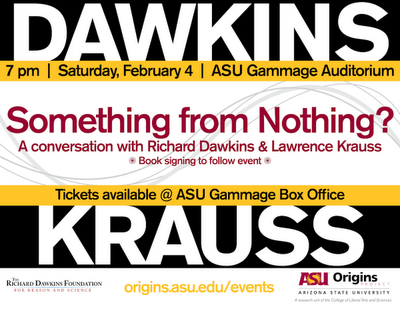
The conference started and the first speaker was introduced and came out. This was the main person I was coming for, Richard Dawkins. Nowadays, most people know him for his book,
The God Delusion, but he was a hugely influential evolutionary biologist and that is what he was speaking on this day. He spoke for about an hour and took some questions at the end. They primarily dealt with evolution but one questioner tried to bring up atheism and was rebuffed by the moderator. This symposium was to deal with the "origins" of the universe, of life, etc. If you opened up the can of worms of religion, you could fill several more symposiums. Dawkins was funny, conversational, intelligent and I'm glad I finally had the chance to see him in person.
The second speaker was Craig Venter. He is generally considered to be the first to map the human genome. There is some controversy on this point, but Venter is very active in genomic research and we haven't heard the last from him. He has a non-profit organization with over 400 scientists that continue to work in this field. His talk was a bit dry for my taste, not as funny as Dawkins. And I wasn't as nearly interested in his subject matter as the other speakers. The questioners at the end of his talk generally seemed to ask about the ethics of genomic research and of patenting of genomes.
Lawrence Krauss, the head of the Origins Initiative at ASU and a world-renowned author and theoretical physicist, was the third speaker. I didn't know a a lot about him going in but was very impressed. He was very charismatic and funny. He organized the symposium and was able to assemble a large number of Nobel winning physicists and chemists plus a collection of some of the most popularly known scientists and intellectuals in the world (Dawkins, Brian Greene, Christopher Hitchens, Venter, Stephen Pinker, etc.) He primarily talked about the origins of the universe, its age, and its expansion. Though it was a scientific conference, he couldn't resist a gentle dig -- Krauss commented that the universe has been measured to be about 13.7 billion years old, except for those people in Texas at the school board he just spoken to the previous week.

The last presentation was a round table of 6 Nobel Prize winning scientists moderated by Ira Flatow of
NPR's Science Friday. Flatow led the sometime contentious discussion by the following scientists: Sheldon Glashow, David Gross, John Mather, Frank Wilczek, Walter Gilbert and Baruch Blumberg. Though they were all courteous and generally amusing, you can sense some fundamental differences in how they viewed popular physics subjects such as
string theory,
supersymmetry, and the
Large Hadron Collider. It was all incredibly fascinating and I wish I could listen to people like this all the time.
This presentation again ended with some audience questions and you knew someone would just have to put a fly in the ointment. Flatow had begun the presentation with a comment about how it was nice for science to now be viewed in a more positive sense and for it to have a seat at the table, unlike the last 8 years. This is a point that no rational person could disagree with and I would guess that 99.9% of the audience agreed with. Well, that one person that disagree had to ask a question. A lady came up and said that she had no idea what he was talking about when he said that science has not been appreciated politically or popularly recently. And even before she said it, I knew she was going to somehow dovetail this into a religious question. She brought up
Francis Collins as a means of saying that religion and science can coexist. For those who don't know who he is, he is a geneticist very instrumental in the mapping of the human genome, a contemporary of Venter. Christians love him because he is the one scientist in a 1,000 who will admit to being a Christian. It's sad really ... kinda like saying there are Republican actors by bringing up Stephen Baldwin or Angie Harmon. If you have to bring up Stephen Baldwin or Angie Harmon in any discussion, your argument is already lost.

Flatow was polite with the lady but opened up the discussion to the scientists in the panel who, to a man, brought up how science was the search for truth, where ever it may lie. They were all gracious, intelligent and profound and were met with raucous applause ... answer enough to the lady whose intent was to reconcile faith and science, at least in her own mind.
Overall, the conference was very enjoyable. It's encouraging that a show with a bunch of crusty old scientists talking can sell out a 3,000 seat theater in a conservative, largely religious and sometimes distinctly anti-science state. Maybe times are changing.